


The Quiet Crisis in Companion Animal Health
What Every Pet Brand Needs to Know about Joint Health in Animals
Walk into any veterinary clinic on a Tuesday afternoon, and you’ll see it. The older poodle struggling to climb onto the exam table. The middle-aged shepherd mix who’s “just slowing down.” The cat who stopped jumping onto the windowsill months ago.
Arthritis and musculoskeletal discomfort are the silent epidemics of companion animal health. And for formulators paying attention, they represent one of the most significant ingredient opportunities in the pet space today.
It’s a Bigger Problem than People Realize
Pet owners and even some industry insiders tend to think of joint disease as a “senior animal problem.” It isn’t. Arthritis is a degenerative joint disease in which the protective cartilage in the joint breaks down, causing pain, inflammation and stiffness, and it can begin years before clinical signs become obvious to owners.
The numbers tell the story:
- Up to 52% of dogs & cats experience joint issues at some point in their lives
- Nearly 36% of dog & cat owners currently buy joint supplements
More and more pet parents are recognizing that their companion animals are suffering. As this awareness grows, more of them will seek solutions. It’s the market opportunity hiding in plain sight, and it belongs to the brands that bring science forward.
That’s exactly the problem Exclzyme Pet™ was formulated to solve. Backed by a randomized, double-blind, placebo-controlled clinical trial on dogs with arthritis, our systemic enzyme blend gives formulators something the pet category has been missing: species-specific, statistically significant clinical data.
Why Musculoskeletal Discomfort is Different from Other Pet Health Categories
Joint issues are not a static condition. They compound. Without intervention, osteoarthritis worsens over time, leading to the formation of osteophytes (bone spurs) and restricted mobility. Chronic discomfort drives behavioral changes such as irritability, reduced appetite and diminished interest in play or exercise.
Translation for product developers: joint discomfort impacts the vast majority of pets over their lifetime. Pet parents notice when their dog stops greeting them at the door. They notice when their cat stops playing. They notice the limp, the reluctance to climb stairs, the difficulty rising.
It’s a dynamic that creates three commercial realities every formulator should take into consideration.
- Demand is durable
Joint disease is progressive. Pet parents who find a product that works tend to keep their pets on it for life. - Results are everything
Owners are watching their pet for signs of relief. Products that don’t deliver get dropped fast. - Science sells
With scrutiny of pet supplements rising, brands backed by real clinical data have an enormous edge over those that rely solely on category-standard ingredients.
The Secondary Opportunity: Get Ahead of the Damage
By the time most owners go looking for a solution, the underlying degeneration has been progressing for some time. Emerging science suggests that starting companion animals on joint support earlier in life can help maintain healthy joint function and support normal mobility before clinical signs surface.*
For formulators, the implication is significant. Joint health doesn’t have to be a senior-pet category. Positioned correctly, it becomes a lifelong wellness category years before symptoms appear. It’s the same ingredient story, the same clinical credibility, and a market several times larger than the reactive senior-pet segment alone.
The Pet Supplement Market is Growing
The U.S. pet supplement market was valued at $895.91 million in 2023 and is projected to reach $1.475 billion by 2032, a CAGR of 5.7%.

Joint health is consistently one of the top-selling functional categories within that total.
Driving forces behind the growth:
- Humanization of pets
Owners now think of supplements for their companion animals the way they think of supplements for themselves, and they want the same quality and level of evidence behind both. - Aging pet population
Improved veterinary care means more dogs and cats are living long enough to develop chronic joint disease. - Shift away from long-term NSAIDs
Owners and veterinarians alike are looking for safer, sustainable, daily-use alternatives for managing chronic discomfort.
For ingredient buyers, the implication is clear. The brands winning shelf space will be the ones formulating with ingredients that have been clinically validated, not just historically used.
Where the Industry Has Fallen Short
Many pet supplements borrow human research and assume it will translate. Others rely on anecdotes, testimonials and pet-parent reviews in lieu of controlled trials. Brands deserve more from their ingredient suppliers. Companion animals deserve more from products.
The pet category is maturing fast, and the bar for evidence is rising with it. Retail buyers, veterinary recommenders and discerning pet parents are starting to ask harder questions:
- Was the study done on animals?
- Was it placebo-controlled?
- What were the actual outcomes?
Brands that can answer these questions are ahead of the game.

Clinical Science Built for the Companion Animal Category
Exclzyme Pet™ is a clinically studied systemic enzyme blend shown to improve joint health in 92% of dogs.
Exclzyme Pet™ supports:
- A healthy response to inflammation*
- Joint function and mobility*
- Comfort and ease of occasional discomfort*
- Normal movement and musculoskeletal health*
- Improved antioxidant status*
It’s not a reformulation of a human ingredient with a paw print on the label. It’s a pet-purposed systemic enzyme blend, and it’s been studied in the kind of trial that human ingredients in the nutraceutical space typically have to pass.
The Study that Changes the Conversation
Study Design: Randomized double-blind, placebo-controlled interventional trial
Population: 24 dogs with arthritis
- 12 dogs received Exclzyme Pet™ at 1 g twice daily
- 12 dogs received a placebo
Timeframe: 30 days
Assessments:
- Pain scores
- Degree of lameness
- Joint mobility
- Radiological evaluations
Results:
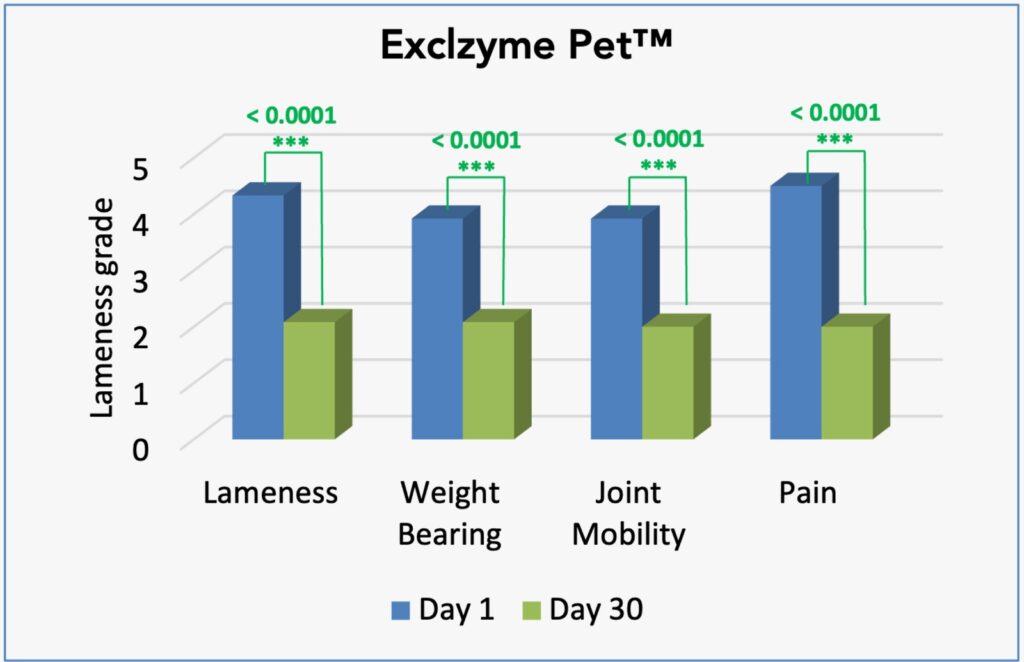
The results were striking. After 30 days, Exclzyme Pet™ led to statistically significant reductions across the board:
- 52% ↓ in lameness*
- 46% ↓ in weight-bearing issues*
- 49% ↓ in joint mobility issues*
- 56% ↓ in pain*
The dogs also demonstrated a 58% increase in their willingness to hold up a contralateral limb.*
Why this Study Matters
In the human nutraceutical world, randomized double-blind, placebo-controlled trials are the price of admission for any ingredient claiming serious clinical credibility. In the pet category, they are still the exception, not the rule.
A randomized double-blind, placebo-controlled trial conducted on dogs, with statistically significant outcomes across pain, mobility, lameness and radiological markers, is a different category of evidence entirely.
For brands, it means three things:
- Stronger label claims supported by real species-specific data
- Better positioning conversations with retailers and veterinarians
- More direct story to tell pet parents who are tired of marketing dressed up as science
What this Means for Your Formulation Pipeline
If you’re evaluating your joint health roadmap, here are the questions worth asking:
- Does your current joint formula rely on ingredients with clinical data from companion animals?
- Could your product line benefit from a systemic enzyme approach that supports joint, tendon, muscle and tissue health from one ingredient?
- How would a clinically validated, statistically significant dog study reshape your retail conversations and consumer marketing?
The Quality Behind Exclzyme Pet™
Exclzyme Pet™ can be formulated into capsules, packets and powders. It is manufactured in NSF GMP, FSSC 22000 and ISO-17025 certified facilities, and is vegetarian, gluten-free, halal and kosher certified, giving brands flexibility across positioning, channel and end-consumer values.
We don’t take shortcuts in the pet category. Exclzyme Pet™ is clean-label, sourced and produced to the same rigorous standards we apply to our human nutraceutical ingredients.
And remember, Specialty Enzymes & Probiotics brings 45 years of nutraceutical expertise, deep R&D and formulation support and some of the shortest lead times in the industry. The result is faster speed to shelf, stronger technical guidance and an ingredient manufacturer that understands what it takes to design a clinically backed pet product.
Joint health is one of the largest and fastest-growing pet nutraceutical categories in the country. The brands that lead it from here forward will be the ones built on real clinical evidence. We’d be honored to help you get there.

Meet Our Technical Team at NASC 2026
Stop by our table at NASC, May 19-21. Our technical team will be on site to answer your questions and help you figure out how to be the brand to beat. Or schedule a meeting in advance to ensure you have the opportunity to explore your options with us.
Sources
- AstuteAnalytica India Pvt. Ltd. (2024, June 17). Astute Analytica. GlobeNewswire News Room.
- Arthritis can affect dogs of any age, including puppies. Anderson, K. L., Zulch, H., O’Neill, D. G., Meeson, R. L., & Collins, L. M. (2020). Frontiers in Veterinary Science, 7.
- Wangikar et al., 2026. Advanced Enzymes proprietary clinical study